☕ The short version (for those with 60 seconds)
- 🏢 What it does: gives big companies one place to handle internal business: from a broken laptop, through leave requests, to a customer complaint.
- 💰 How it earns: subscriptions. About 97% of revenue is recurring.
- 🔒 Why customers stay: replacing such a system means months of work, big costs and even bigger migration risk, so swallowing a price increase is easier.
- 🧮 My valuation: 163 USD per share in the base case, against a price of 137.87 USD. But if you count share-based pay as a full cost, you get about 115 USD. I explain the gap below.
- ⚠️ Next test: Q3 results on 28 October, after the market closes.
- 🤝 Full disclosure: I own shares in this company, and for years before that I used its system every day.
History: where this company came from
📉 The man who lost everything just before fifty
This story starts with a failure, not a success.
In the early 2000s Fred Luddy was chief technology officer of Peregrine Systems. The company collapsed under an accounting scandal, and his entire fortune went with it, because Luddy kept it in its shares. As he later recalled, 35 million dollars turned into zero in an instant.
Most people in that spot would look for a quiet job. Luddy did the opposite. In 2004, two weeks before his fiftieth birthday, he started a new company. He explained later that after fifty a fresh start would have seemed unrealistic. He called it Glidesoft (formally the company may date from a year earlier).
💡 A broken laptop as a business idea
The idea did not sound like a revolution. Just a system for handling IT requests. The devil was in the detail: it ran in a browser, not on servers the customer had to install and look after. For those times that was cheeky.
You know this from work. Your laptop breaks and instead of hunting for "that computer guy", you file a request in one place. It lands with the right people on its own, you can see what is happening to it, and they know what to do. Simple? That is exactly why it worked.
In 2006 the company took the name we know today: Service-Now.com.
🎲 The best decision is the one not taken
At the end of 2009 the Sequoia fund believed in the company and led a 41 million dollar funding round. A year later an offer arrived that the industry still talks about: VMware wanted to buy the company for about 2.5 billion dollars.
A few years after Luddy lost everything, billions were on the table. The company was reportedly willing to accept. Then Doug Leone of Sequoia stepped in and convinced the board that ServiceNow would be worth ten times more.
The market proved him right faster than anyone could expect. In 2011 Frank Slootman took the helm, and on 29 June 2012 the company debuted on the New York Stock Exchange. Shares were sold at 18 dollars, above the range the company itself had set. By the end of that year ServiceNow was worth 3.7 billion dollars, more than VMware had wanted to pay.
👔 From help desk to company command centre
Slootman left in 2017. After a short spell under John Donahoe, Bill McDermott, formerly head of Germany's SAP, took over at the end of 2019. Under him a tool for the IT department grew into something much bigger: the Now Platform, one system in which a company runs IT, security, HR, customer service and risk.
When the world went mad for artificial intelligence, ServiceNow did not stand aside. In July 2023 it added generative AI to the platform (Now Assist), and then went shopping: in March 2025 it bought Moveworks for about 3 billion dollars, and in December it announced the purchase of Armis for 7.75 billion. A company that started with tickets for broken laptops sold over 13 billion dollars of services in 2025.
☕ Why this company ended up in my portfolio
I have to admit something here. Before I started analysing ServiceNow, I simply used it. Every day. And honestly, I could not imagine how my corporation would function without it.
So when the "SaaSpocalypse" came, the big sell-off of companies selling subscription software, and ServiceNow's share price dived, buying was a formality for me. I had seen from the inside how deep this system sits in the daily work of thousands of people.
It was similar at my previous firm with CrowdStrike, after its flash crash. But that is a story for another coffee.
So I have a stake in this story, and I say so openly. All the more reason to make sure the numbers keep talking, not my fondness for a tool I used every day.
🔒 And here it gets interesting
Customers who have deployed such a platform usually do not leave. I know that from my own desk. And the company has just decided to test how much that loyalty is worth.
In April 2026, according to market reports, ServiceNow replaced its five licence tiers with three packages (Foundation, Advanced and Prime), with AI included in each. From 1 July the old packages can no longer be bought. The CFO spoke of expected price increases of 20-30%.
Will the moat hold when its owner raises the toll for crossing the bridge?
Products, services and the revenue model
🏢 Picture a company with 10,000 employees
Every day somebody needs something:
- a new team member needs a laptop, accounts in several systems and an access card,
- someone else takes leave,
- a customer files a complaint,
- the security team spots a suspicious login.
In many companies all of that happens in emails, spreadsheets, phone calls and in the style of "I'll remind you tomorrow".
Example (an illustration, not a description of a real customer): Ania is joining the company.
- ❌ Without a shared platform: HR emails IT, the email gets lost, and Ania sits for three days without a computer or access to systems.
- ✅ With ServiceNow: HR ticks "new employee" in the system, and the system creates tasks for IT (laptop), security (access) and administration (card) by itself. Everyone sees what they have to do and by when.
That is what ServiceNow sells: order in the flow of work. The modules cover IT service and operations management, security, HR, customer service and risk.
Recently AI agents have been added: programs that carry out part of the steps in such a workflow themselves. In our example it is as if some of the steps for onboarding Ania were done not by a person but by a program.
💸 Why the customer pays
Because they get order where there was chaos, and they save the time of expensive people.
The company says its AI products passed 1 billion dollars of annual contract value (ACV, meaning how much customers pay for them per year) in Q2 2026.
🔁 Where the money comes from
Think of a phone plan or a streaming subscription, only for companies and for millions of dollars.
- The customer pays every year for access to the platform.
- In 2025 subscriptions brought in 12.88 billion of 13.28 billion dollars of revenue, about 97%.
- That makes revenue predictable. The company largely knows how much it will earn next year before that year begins.
You can see it well in cRPO. That is money from contracts already signed that the company will show as revenue within the next 12 months. In Q2 2026 it was 13.20 billion dollars, 21% more than a year earlier.
🥊 Who can take that money away
- Competitors. Microsoft and cloud providers build AI into tools the customer already has and already pays for.
- The customers themselves. They can build their own tools on AI models instead of buying ready-made ones.
ServiceNow's protection is switching cost. Replacing a platform that runs the processes of a whole company is like replacing the wiring in an office tower that is in use. It can be done, but few people do it to save on the electricity bill.
Because the cost of switching is far more than the price of a new licence:
- 🗄️ Data migration. The system holds years of history: requests, changes, access rights, contracts. Moving it to another tool always carries the risk that something gets lost, breaks or loses its links. And in a large company, especially a regulated one, lost history is not a trifle but an audit problem.
- 🔌 Integrations. The platform is plugged into HR, accounting, email and security systems. Every such connection has to be built again and tested.
- 👩🏫 People. Thousands of employees know their way of working by heart. A new tool means training, new habits and a period when everything runs slower and requests get lost because "it was different in the old one".
- ⏳ Transition period. For months a company often runs both systems at once and pays twice, while the IT team deals with the move instead of developing the business.
All of this together means a price rise of several dozen percent can still come out cheaper than moving house. And the whole thesis rests on exactly that.
📊 What profitability depends on
Two things:
- How much it costs to run AI. AI models use a lot of computing power. Non-GAAP subscription gross margin (how much of every 100 dollars of subscription is left after the cost of delivering it) fell in Q2 2026 to 80.5 dollars from 83 a year earlier. For the whole of 2026 the company assumes 81%.
- How much of pay is in shares (SBC). The company reports a non-GAAP operating margin of 31% for 2025, but once pay in shares is counted (GAAP) it is only 13.5%. That gap is the heart of the whole valuation, so it gets its own chapter below.
The thesis in 3 sentences
- 🔒 ServiceNow is a company that is hard for customers to leave, it grows by over 20% a year and its balance sheet carries no excessive debt.
- 🧮 Under my assumptions, where I treat pay in shares as a non-cash cost, fair value is about 163 dollars against a price of 137.87 dollars, so in my opinion the stock is cheap today.
- ⚠️ That value depends heavily on how SBC is treated and on whether growth after the price rises is lasting, and the first hard test is the Q3 results.
Financial position
| 2024 | 2025 | Q2 2026 | |
|---|---|---|---|
| Total revenue | 10,984 USD m | 13,278 USD m (+21%) | 3,987 USD m (+24% y/y) |
| Subscription revenue | n/a | 12,883 USD m | 3,877 USD m (+24.5% y/y) |
| GAAP operating margin | n/a | 13.5% | 4% |
| Non-GAAP operating margin | n/a | 31% | 29.5% |
| Free cash flow (FCF) | 3,455 USD m | 4,636 USD m (35% margin) | non-GAAP margin 16% |
| GAAP net income | 1,425 USD m | 1,748 USD m | 298 USD m |
📖 How to read this table without a dictionary:
- GAAP is the official US accounting standard. It counts everything, including pay in shares.
- Non-GAAP is a result "cleaned" by the company itself, mainly of the cost of share-based pay. It usually looks nicer.
- FCF (free cash flow) is the cash that really stays in the company after paying for operations and investment. It is what the company can use to repay debt, buy other companies or buy back shares.
🔭 What the company guides for 2026:
- subscription revenue of 15,760-15,780 million dollars (+22.5%),
- non-GAAP operating margin of 31.5%,
- FCF margin of 35%,
- in Q3 alone, subscription growth of 20.5% y/y.
In Q2 the company did not buy back shares (in the first half it bought back 2,225 million dollars).
🏦 Debt. At 30 June 2026 net debt was 810 million dollars (debt 7,517 million, cash and securities 6,707 million). As recently as December 2025 the company had net cash of about 8.6 billion dollars. Acquisitions and debt issues made the difference. The balance sheet is still healthy, but the direction of change is clear.
🏷️ What the whole company costs. The market values ServiceNow at 142.6 billion dollars (price 137.87 USD at the 7 October 2026 close), with a P/E of 83.6 (TTM, GAAP) and a 52-week range of 81.24-192.97 USD.
What does a P/E of 83.6 mean? For every dollar of annual accounting profit you pay 83.6 dollars. If profit never changed, the company would "earn its own price" in over 80 years. This is not a cheap stock on simple multiples, so the whole thesis rests on the cash the company will generate over a decade, not on today's profit.
💡 Pay in shares (SBC), in plain language
This is the most important chapter for understanding the valuation, so let us take it in pieces.
What SBC is
Technology companies pay part of their staff not only a salary but also shares. A programmer, say, gets a transfer every month and on top of that a package of company shares every quarter.
At ServiceNow that is a lot: 14.7% of revenue in 2025 and 16.4% in Q2 2026. So out of every 100 dollars customers pay, about 15-16 dollars is "spent" on pay in shares.
🍕 Dilution, or a pizza cut into more slices
Imagine a pizza cut into 8 slices. You hold one, 12.5% of the whole.
To pay its staff the company adds new shares. That is like cutting the same pizza into 9 slices. Your slice is now smaller (11.1%), though nobody took anything off your plate.
That is shareholder dilution: the company's results are split across more shares, so each share gets less.
Companies often try to offset it by buying shares back from the market. ServiceNow bought back 2.2 billion dollars of shares in the first half of 2026. Only then the cost is paid in real cash.
📄 Paper profit versus 💵 cash
Here is the catch that makes two people looking at the same company reach completely different conclusions:
- In the income statement (GAAP) SBC is a cost. Hence an operating margin of only 13.5%.
- In the cash flow statement SBC is added back, because no money left the account. Hence the impressive 4.6 billion dollars of free cash and a 35% FCF margin.
Both numbers are true. The question is: is pay in shares a cost or not? Critics of SBC answer: it is a cost, just paid differently. Not by the company from its account, but by you, the shareholder, with a slice of your pizza.
⚖️ Two valuation variants, side by side
| Variant | How I treat SBC | Base value per share | Against the 137.87 USD price |
|---|---|---|---|
| A. "Cash" (my base case) | as a non-cash cost, the way cash flow statements show it (market convention) | 163 USD | about 18% above the price |
| B. "Full cost" | as a normal cost, falling from about 16% to 10% of revenue (in line with the company's target for 2029) | about 115 USD | about 17% below the price |
Variant A is kinder to the company because it ignores dilution. Variant B is harsher because it assumes somebody does pay for those shares in the end.
I show both on purpose. My value of 163 USD is not a fact, it is the result of a choice that you can challenge. If you prefer to count conservatively, variant B is your reference point.
Valuation
🧮 How I calculate it (no formulas)
I use a DCF model. It sounds scary, but the idea is simple: how much all the money the company will earn in the future is worth today.
The catch is that 100 dollars in 10 years is worth less than 100 dollars today: there is a risk it will not be there, and today you can put it to work somewhere. So I "discount" future money by the cost of capital, the minimum annual return I expect for the risk.
What exactly I assume in the base case:
- 📈 Revenue growth averaging about 18.6% a year over 2026-2030. That gives about 31 billion dollars of revenue in 2030, including over 30 billion from subscriptions, which is what the company itself guides to.
- 💪 EBITDA margin before SBC (operating profit before depreciation and share-based pay) rising from 37.5% to 40%.
- 🎯 Cost of capital of 9.5% a year.
- ♾️ Perpetual growth of 4.0%, the pace at which I assume the company will keep growing for ever after the ten-year forecast.
- 🔄 Negative working capital: customers pay up front, so the company receives cash before it delivers the service.
The model covers 10 years: five years of detailed forecast and five years of gradually slowing growth. I run three scenarios weighted 25/50/25. You can download the model and replace my assumptions with yours.
🎭 Three scenarios
Pessimistic
89 USD
growth about 14.7% on average, margin to 35.5%, cost of capital 10.5%, perpetual growth 3.5%; probability 25%
Base
163 USD
range 149-180 USD; growth about 18.6% on average, margin to 40%, cost of capital 9.5%, perpetual growth 4.0%; probability 50%
Optimistic
233 USD
growth about 20.4% on average, margin to 42.5%, cost of capital 9.0%, perpetual growth 4.5%; probability 25%
The weighted average is about 162 USD, which is 17% above the price.
🔄 The same thing from the other side
You can also ask the reverse: what assumptions "sit" in today's price? A price of 137.87 USD corresponds, in the base scenario, to a cost of capital of about 10.5%. So the market demands one percentage point more for this risk than I do.
🎚️ What moves this number most
- SBC. Described above: changing the approach moves the base value from 163 to about 115 USD. At its Financial Analyst Day the company committed to cut SBC below 10% of revenue by 2029, and I took that direction for variant B.
- Perpetual growth. At 3.5% the value falls to about 153 USD, at 5% it rises to about 189 USD.
For the curious: the implied terminal EV/EBITDA multiple is 13.7 in the base scenario, and terminal value makes up 66% of enterprise value. Details are in the model.
The result is a fair value following from the assumptions I made, not a price target or a recommendation.
Catalysts (what could help the company's earnings)
- 📅 Q3 results (28 October, after the market closes). The company guides to subscription growth of 20.5% y/y. If cRPO and gross margin hold up after the pricing change, that will be a strong argument that growth is lasting.
- 🤖 Making money from AI. ACV of AI products has passed 1 billion dollars, and in September 2026 the CFO spoke of raising the 2026 target to 1.5 billion. In Q2 the company had 123 deals worth over 1 million dollars of ACV (almost +40% y/y) and 658 customers with ACV above 5 million dollars (+23%).
- 💵 Returns to shareholders. In January 2026 the board approved an additional 5 billion dollar buyback programme, and in the first half of 2026 the company bought back 2.2 billion dollars of shares.
- 🎯 Company targets for 2030 (Financial Analyst Day, 4 May 2026): over 30 billion dollars of subscription revenue, 30% of ACV from AI and "Rule of 60+" (growth rate plus free cash margin above 60%), plus cutting SBC below 10% of revenue by 2029. These are management's declarations, not forecasts.
Risks (what could prove me wrong)
- 🤖 AI as a competitor, not an add-on. AI agents may replace work that is paid for per seat today. Fewer people in the IT department can mean fewer licences. On top of that, customers may build their own tools on AI models. This risk is long-term and hard to measure in a single quarter.
- ⏩ Demand "borrowed" by the price rise. Analysts worry that some customers renewed early to avoid the new price list. The CFO spoke of early renewals as part of the consumption model. If the worries are justified, Q3 and Q4 will show weaker growth than the last report suggests.
- 📉 Margin. Non-GAAP subscription gross margin fell in Q2 to 80.5% from 83%. If AI costs grew faster than prices, my assumed rise of EBITDA margin to 40% would be too optimistic.
- 🍕 Pay in shares and dilution. Described above: with a different treatment of SBC the base value falls by about a third.
- 🏷️ Valuation. A P/E of about 83 does not forgive wobbles. After the Q2 results the share price fell despite beating expectations on profit and revenue, because the second-half guidance turned out weaker.
- 🧩 Integration and debt. The Moveworks and Armis acquisitions turned net cash into net debt.
- 🔐 Security. In June 2026 a critical vulnerability, CVE-2026-6875 (CVSS 9.5; remote code execution without authentication), was patched. The company saw no evidence that it affected instances it hosts itself. This is a reputational risk, not proof of worse results.
- 🧪 Model limitations. Terminal value is two thirds of the total. Historical data from before 2025 are incomplete and do not affect the result, because the model starts from 2025 revenue.
Conditions that invalidate the thesis
This is the most important paragraph of the text, so I will write it honestly.
We are at a moment when everything converges. The Q3 results are the first report after the pricing change and after AI was written into the basic packages. Everyone will be looking for one thing: whether the outlook is what management promises.
📈 What the chart says. A moving average is simply the average price over the last X days or weeks. It helps you see the trend without daily noise.
ServiceNow (NOW), daily chart
The figures below are a reading from 2 October 2026. The chart above runs live, so the levels will gradually drift away from it.
- On the daily chart the 50-day average (SMA50, 128.34 USD) sat about 10.8% above the 200-day average (SMA200, 115.86 USD). That is the so-called golden cross, which has already formed.
- On the weekly chart the price stood right on the EMA200 line (137.74 USD), just below the SMA200 (143.36 USD) and the resistance zone of 137.7-143.4 USD.
Such boundaries can turn either way, and once they move, the move tends to be decisive.
✋ When I will admit I was wrong. One weaker quarter does not overturn the thesis of a company that is hard to leave. Only a break in the moat itself would. So I will call the thesis out of date only when something happens that shows customers really are leaving, or that AI is eating the profits:
- cRPO growth falls below 15% y/y in two consecutive reports (in Q2 it was 21%);
- non-GAAP subscription gross margin falls below 75% in two consecutive reports (in Q2 it was 80.5%);
- the company cuts its 2026 subscription revenue guidance below 15.46 billion dollars, i.e. to growth under 20% (today it guides to 15.76-15.78 billion, +22.5%);
- the price closes a week below the lowest level of the last 52 weeks (81.24 USD).
🟡 Yellow light. There are also weaker signals that do not overturn the thesis but tell me to go back to the model and check the assumptions: cRPO growth below 18% y/y, subscription gross margin below 79%, any cut to the guidance for 2026, or a weekly close clearly under the weekly EMA200 (137.74 USD) with no return within two weeks. If any of them lights up, I will write about it openly in a follow-up.
The thresholds are mine, chosen in advance so I do not move them after the fact. After the results I will be back with a follow-up text, whether or not I was right.
And you? How do you count pay in shares: as a cost or not? Tell me in the comments.
Disclosure of interests
My cup: I hold a position in the company. That means I have a stake in this thesis turning out right, and that is exactly why the assumptions, scenarios and model are open and the invalidation condition was written down in advance.
Disclaimer
Content on Kawiarnia Rynkowa is for informational and educational purposes only and is not investment, tax or legal advice. Investing involves risk, including loss of capital. The author holds positions in the instruments discussed — see disclosure in the text.
Updates
- ResultsNeutral
ServiceNow after Q3: the company delivered, the share price did not hold
Third-quarter results beat guidance and the 2026 targets went up, but a softer outlook for contracted revenue growth in the fourth quarter contributed to a 27% drop in the share price in a single day. None of my invalidation thresholds broke and the model stays unchanged; one yellow light, the price one, is coming on.
I promised to come back with a "Follow-up" after the results, whether or not I turned out to be right. I am back right away, because the market gave nobody time to catch their breath.
On Wednesday 28 October ServiceNow shares closed at USD 150.13, 9% higher than on the day of my analysis. After the close the company reported. The next day the stock closed at USD 109.67, 27% lower. It was the company's worst session in over 14 years. On Friday it slid further, to USD 105.12.
The most interesting part is that the quarter itself was good. One number in the guidance turned out bad.
What the company reported
Subscription revenue, the subscriptions the company lives on, came to USD 3.99 billion in the third quarter. That is 20.5% more than a year ago in constant currency, half a percentage point above the top of what management itself had promised three months earlier.
The second key number is cRPO. It is the sum of contracts already signed that the company will recognise as revenue over the next twelve months. It is a preview of future revenue, backed by customers' signatures. It grew to USD 13.65 billion, up 21% in constant currency, again above guidance.
The rest also held to plan. Non-GAAP operating margin (before share-based pay and acquisition costs) was 32.5%, and customers renewed 98% of contracts. For the second time this year management raised its AI target: the annual value of contracts is to exceed USD 1.7 billion by year-end, whereas at the start of the year the talk was of 1 billion. Full-year 2026 subscription revenue guidance went up only symbolically (by about USD 20 million), to USD 15.78-15.79 billion (+22.5%), while the guided free cash flow margin rose from 35% to 36% of revenue.
If I had read only this part, I would have expected the share price to rise.
So why minus 27%
Because the market prices mostly what is yet to happen.
For the fourth quarter the company guided to cRPO growth of 18.5%. Analysts had expected roughly 19.5-19.8%. One percentage point sounds harmless, but for a company valued at over USD 150 billion the market reads it as the first sign of slowing, and in the age of AI investors are exceptionally sensitive to slowing.
The CFO listed four reasons. The first: some customers renewed early, already in the third quarter, which accounted for roughly half of the beat in cRPO this quarter. Picture a gym where some members bought annual passes in September instead of December. September looks great and December looks thinner, even though nobody cancelled.
The other three reasons are more technical and, if I read the company's numbers correctly, they explain most of the gap. Contracts that a customer can terminate at any time are no longer counted in cRPO, although they still turn into revenue. That is about half a percentage point. Another quarter of a point comes from a larger share of licences installed on customers' own servers, which enter cRPO differently from the cloud. And in some large AI contracts, implementation support was moved from subscriptions to services, which takes about a quarter of a percentage point off subscription growth (not cRPO) in the third quarter and about half a point in the fourth.
On top of that, non-GAAP earnings per share came in at USD 1.00, two cents below what the market expected, partly because of higher interest after the Armis acquisition, which was partly financed with debt. And the price had been rising ahead of the results, so expectations were high.
Here I have to admit something. In my October analysis I listed among the risks "demand borrowed through the price rise", the worry that customers renew early to escape the new price list. Early renewals did appear, although the company did not say why customers did it, so I do not know whether the price list was the reason. This does not overturn the thesis, but it shows I should have treated that risk more seriously than as one item on a list.
Not only ServiceNow: the whole sector and the calendar
It would be convenient to blame everything on one guidance figure, but that is not the whole truth. The software sector fell together with it, and partly because of it. From 23 to 30 October the fund holding US software companies lost almost 6%, Salesforce nearly 8%, Workday and Adobe around 5-6% each. That figure includes ServiceNow itself, which has its own weight in the fund. ServiceNow's results revived an old fear on the market, that artificial intelligence, instead of adding money to software companies, will start taking it away. Add record spending by tech giants on data centres, which investors increasingly count as a cost and not as a promise. The fear of AI was already in the air, and ServiceNow gave it a pretext and took the biggest hit.
The most striking example is Alphabet, the owner of Google. The day after the ServiceNow report, on 29 October, its shares fell almost 13%. The company lost about USD 475 billion in value in a single session, the largest one-day drop in Alphabet's history and the second largest in the history of the US stock market. The reason was different from ServiceNow's: cloud results were excellent (revenue more than doubled), but search revenue came in below expectations and cash flow turned negative because of AI spending. What they had in common was high expectations. Even a giant worth trillions of dollars is not immune once the market decides that prices demand flawless results.
There is also a backdrop that is easy to forget: the calendar. Today Americans elect Congress in the midterm elections, in the middle of the presidential term. In such years the market has historically pulled back deeper than in other years: the average S&P 500 decline from peak to trough within the year is about 19%, against about 13% in the remaining years.
The other side of that statistic is more interesting. Since 1950 the S&P 500 has been higher a year after every midterm election: 19 times out of 19, with an average return of about 15% (J.P. Morgan data). Six months after the elections it was also higher every time (that is my own calculation on the same 19 cases). This is not a law of nature and this year may be an exception. I treat it purely as background: the calendar does not change ServiceNow's value and does not explain why one company's drop was so violent.
My thresholds: assumption, outcome, conclusion
In the analysis I wrote down in advance when I would admit a mistake, and separately what would be only a yellow light for me, a reason to review the model. Here is the scorecard after the first report.
What I check Invalidation threshold / yellow light After Q3 2026 cRPO growth y/y below 15% in two consecutive reports / below 18% 21%, Q4 guidance 18.5%: within the norm, close to the yellow light (below 18%) Non-GAAP subscription gross margin below 75% in two consecutive reports / below 79% 80% (Q2: 80.5%): within the norm 2026 subscription guidance below USD 15.46 billion / any cut raised to USD 15.78-15.79 billion: within the norm Share price weekly close below USD 81.24 / two weeks below the weekly EMA200 (USD 137.74, reading from 2 Oct) USD 105.12 (30 Oct): yellow light: first week below the average, the second will decide on 6 Nov No invalidation threshold broke. The fundamentals that were meant to prove the moat, namely renewals, margin and guidance, look the way I assumed.
The price light, however, is coming on. We have the first week below the 200-week average behind us, and if on Friday 6 November the price also closes below it, the condition will be formally met. The other thing that bothers me is the 18.5% cRPO guidance. It is half a percentage point from my yellow threshold.
ServiceNow (NOW), weekly chart
Charts and market data: TradingViewThe chart is live. Levels, dates and figures in the text are from the day the lesson was published. What about the valuation
By the rule I set myself, I change the model only when a quarter changes the picture of the next several years. This one did not. My base scenario assumed 2026 revenue growth of 22%, and the company now guides to about 22.5% for subscriptions alone, which make up the vast majority of revenue. So I leave the assumptions alone and replace only what changed: the price, net debt (down from about USD 0.8 to about USD 0.56 billion) and the share count (up from 1.034 to 1.043 billion).
The result barely moves. The pessimistic scenario gives USD 88, the base USD 162 (instead of 163), the optimistic USD 233. The variant in which I count share-based pay as a full cost still gives about USD 115.
ServiceNow share price against my two valuation variants (USD per share)
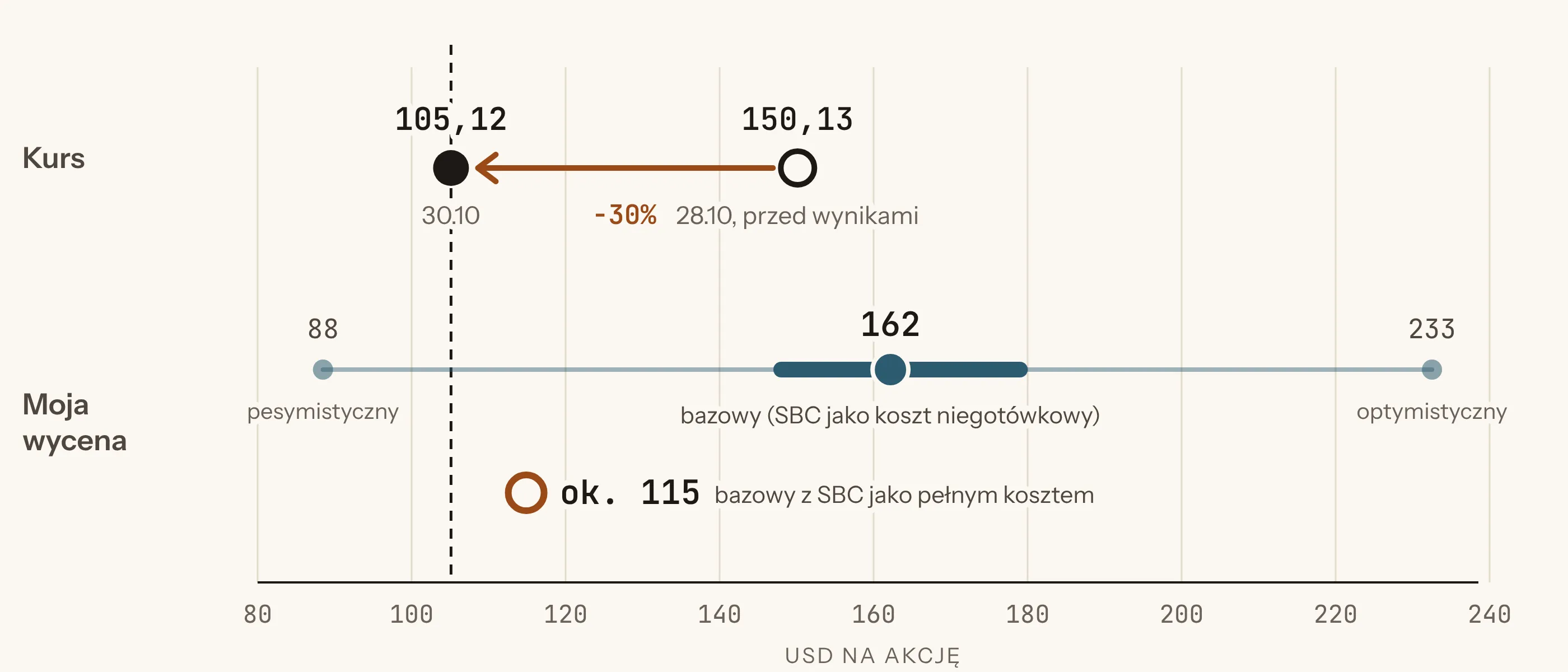
Something else has changed. In October I wrote that whether ServiceNow is cheap or expensive depends on one accounting decision: at USD 163 it looked cheap, at USD 115 expensive, and the price sat in between. Today the price is below both numbers. Even if I treat share-based pay as harshly as possible, the model comes out about 9% above the price.
Put differently, with my growth and margin assumptions the market is pricing this company as though an investor demanded over 12% a year in return, not the 9.5% I assumed. Or it assumes slower growth than I do, or it simply judges the risk differently. That is the whole game: either the market sees something I do not, or it overreacted. The next reports will settle it.
After the results brokers mostly cut their price targets, usually by USD 5-20 (a few raised them), but almost all stayed with positive ratings. The spread is wide, from about USD 110 to about USD 200. Some judged the sell-off excessive, others write that the acceleration thanks to AI will have to be waited for. Management itself says it sees real revenue acceleration in 2027.
Share-based pay: one thing I do not like
In the third quarter share-based pay cost USD 633 million, about 15% of revenue. Unchanged, that is known background. What is new: this quarter the company did not repurchase a single share, although in the first half it spent USD 2.2 billion on it.
Remember the pizza from the analysis? When a company pays staff in shares and does not buy them back from the market, the pizza is cut into ever more slices and your slice shrinks. The share count rose in the model by less than a percent, so it is not a drama yet. But management has declared it will bring share-based pay below 10% of revenue by 2029. I will check whether that path begins, and until then whether buybacks return. That is why it goes on the list below.
What I watch until the next results
The next report is expected at the end of January 2027. Until then I am watching three things. First, whether fourth-quarter cRPO comes in above the guided 18.5% or below, and especially below 18%, which would light the second yellow light. Second, whether the acceleration for 2027 promised by management shows up in guidance or stays only in words. Third, whether buybacks return.
If something on that list goes badly, I will write about it here, in the "Follow-up", as openly as today.
Disclosure of interests
One thing that was not in the October analysis, because it happened after publication: before the report I sold half of my position, and after the drop I bought that half back. For that time, "I own shares" from that text meant a smaller position than on the day of publication. I say so openly, so nobody reads that disclosure differently from how it was true.
I do not treat this as proof that I knew what would happen. This time the move worked out, but I could just as well have bought back higher. What matters to me is that after the results the fundamentals look the way I assumed, and the price is below both of my valuation variants.
I own ServiceNow shares, so I have a stake in this thesis proving right. That is why I wrote the thresholds down in advance and settle them publicly, including when the market says something different from me.
And how do you read it: is 27% down for one percentage point of guidance an overreaction, or a warning I should not dismiss? Tell me under my post about this entry on X, LinkedIn or Facebook.
Disclaimer
Content on Kawiarnia Rynkowa is for informational and educational purposes only and is not investment, tax or legal advice. Investing involves risk, including loss of capital. The author holds ServiceNow (NOW) shares.
Disclosure as of the update: The author owns shares of the company.
Let's talk under the post
I collect comments where the conversation happens. Pick a platform to open the post about this article.
Opens in a new tab, or in the app on your phone.
Was this analysis helpful? Buy a coffee.
Support lets me publish more material, with no paywall.